
I wanted to read the book that inspired my favorite game reveal of last year, Clair Obscur: Expedition 33, but there was a major hurdle: it wasn't available in English. Determined to experience the source material, I bought the French edition on the Kindle store and have begun the painstaking process of translating it page-by-page using the in-app tool.
Sure, I’ll miss the nuance and linguistic gymnastics of the French language, and it would be a bit of a ball ache to highlight, translate, and digest every single page in its "Fringlish" form. However, I if it was the only way to get the gist of the core themes and understand the text that birthed the game's world, so be it. Ironically, this arduous process has made me feel like a member of the Horde itself—struggling against a linguistic gale just to gain a few inches of progress.
Alain Damasio's 2004 novel, La Horde du Contrevent (The Horde of the Counterwind), is an epic tale of perseverance and futility. It centers on a group of specialists seeking the "Extreme-Reach," the supposed source of an eternal, destructive wind. The narrative follows the 34th Horde—one of many expeditions across generations—as they journey against an all-consuming wind that shapes their world and threatens their existence. Every previous expedition has failed, yet each successive group learns from the remnants of their predecessors. They push on with the somber mantra, "For those who come after." But will any Horde actually make it? And if so, what will they find?
The novel grapples with themes of collective endeavor, the nature of progress, and the cyclical futility of human effort. It’s a story of desperate hope, where even in failure, a kind of knowledge is gained—a small step toward comprehending the incomprehensible. It is a profound meditation on humanity’s relentless pursuit of understanding in the face of insurmountable odds. In the words of the game it inspired: "We continue."
One of the many aspects I’m enjoying is the innovative narrative structure. Each character is given a unique voice, signaled by a specific typographical symbol (like Ω for the leader Golgolth or π for the scribe Pietro) rather than a name at the start of a paragraph. This isn't just a stylistic choice; it mirrors the specialized roles within the party. Much like an RPG, which features a diverse party of characters, the distinct viewpoints of wind-tappers, fighters, and scribes create a multi-layered tapestry of a world experienced from twenty-three different angles. This approach makes the characters feel genuinely distinct, immersing me in their individual triumphs and burdens.
The first chapter, Pharéole XIX, utilizes a "scattergun" approach where perspectives shift constantly. It was breathtaking and confusing, especially as I was parsing Bing-translated text on a phone screen. I realized later that this chaos is intentional; Damasio uses the prose to simulate the physical battering of the wind. With a little focus, the rhythm has become more intuitive. By the time I reached the following chapter, Chrones XVIII, the narrative settled into a more straightforward flow. Thank goodness, because a 700-page "tough hang" in the style of the opening would have been a monumental challenge.
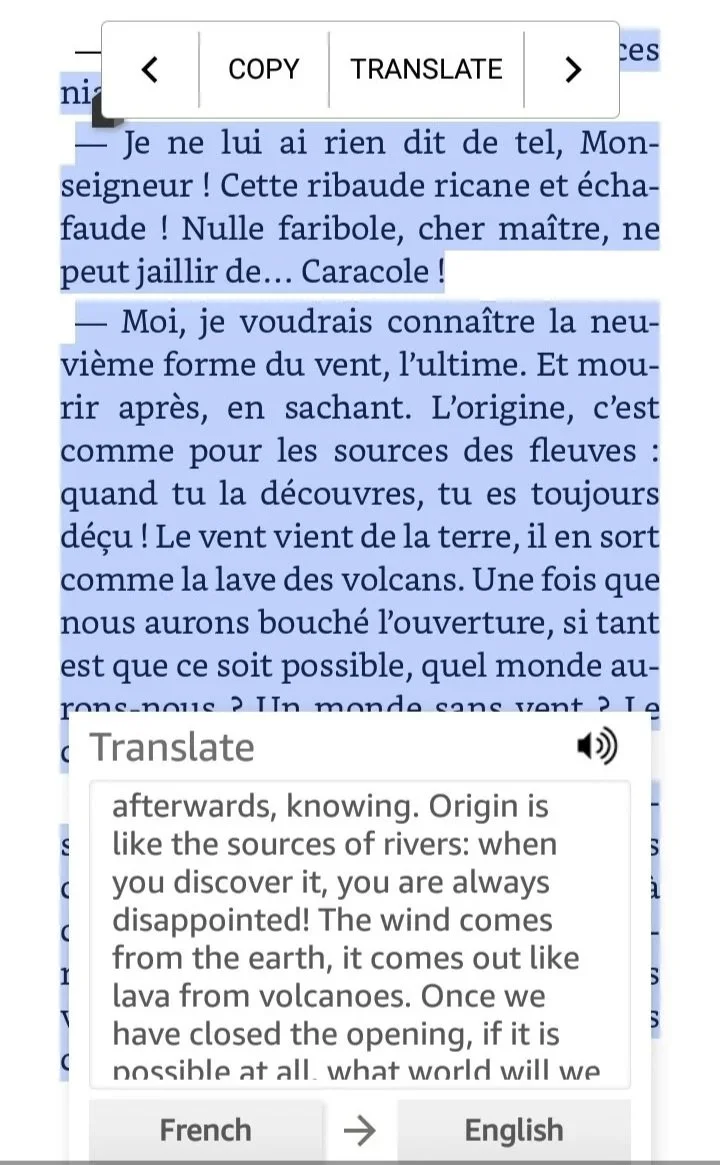
I can now see why a full English translation is a daunting proposition. For a cult book that requires such a high level of linguistic precision, the return on investment might seem risky. However, I believe this book would excel not just within the gaming community, but in the wider literary sphere. Its premise is utterly novel and told with incredible structural ingenuity.
While a translation can never fully capture the intricate wordplay of Damasio’s French, a professional English release would finally provide readers access to this powerful narrative. Even with my janky, onerous translation method, the story's depth shines through. I intend to continue braving these linguistic winds to see if the source of the gale is worth the effort. Once I've reached the end, expect a detailed review.