
There Is No Antimemetics Division is a masterclass in conceptual horror—a subgenre that posits the most lethal monsters aren't lurking in the shadows, but in the corners of our minds that we can no longer access.
Building upon the collaborative mythos of the SCP Foundation, author qntm’s novel shares a creative lineage with the Remedy-verse (Control, Alan Wake), the ergodic disorientation of Mark Z. Danielewski’s House of Leaves, and the fragmented storytelling of Christopher Nolan’s Memento.
The narrative follows Marion Wheeler, the director of a department that, by its very nature, cannot exist. Her team’s mandate is to contain antimemes: ideas that possess a self-censoring quality. An antimeme is a secret that actively defends itself; to perceive one is to immediately purge it from memory. To be targeted by one is to have your entire existence redacted from the consciousness of everyone you’ve ever known.
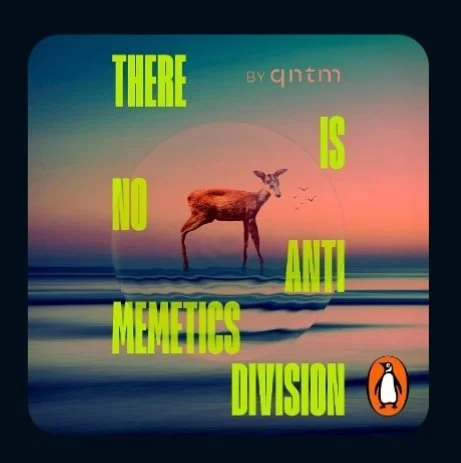
Wheeler’s world is defined by a permanent sense of intellectual vertigo. The narrative structure is brilliantly fragmented, mirroring the characters' fractured psyches as they utilize mnestic drug regimens—chemical catalysts that force the brain to retain information it is biologically wired to reject. They are fighting a war of attrition against an enemy they cannot remember. The stakes are ontological in the truest sense: if the enemy triumphs, humanity won’t just perish; it will be retroactively erased from the historical record.
Writing as qntm, Sam Hughes employs a lean, clinical style, cutting through the complex techno-babble of information theory with an administrative efficiency that makes the horror feel grounded in a chilling, bureaucratic reality.
The story is a meditation on the isolation of competence; Wheeler is a protagonist defined not by destiny, but by a dogged, sacrificial refusal to look away from the abyss, even as it erodes her sanity. As the narrative expands, we meet concert violinist Quinn, who becomes an unlikely but relatable journeyman. Alongside a general knowledge eating antimeme, Quinn tries to salvage the remnants of humanity. It is a story grand in scale and scope, yet intimate enough to make the reader feel the weight of small victories against impossible odds.
Conceptually, the story feels like a dark evolution of Steven Hall’s The Raw Shark Texts. Both novels explore a conceptual ecology where ideas are apex predators. Where Hall gives us the Ludovician—a conceptual shark that swims through the stream of human consciousness—qntm presents SCP-3125: an ideatic entity so aggressive that to even comprehend its geometry is to be consumed by it.
These U-category anomalies further echo the surreal horror of Neon Genesis Evangelion; like the Angels, they are unique, incomprehensible entities seeking to break the human AT Field and trigger a terminal singularity. qntm offers a clinical, high-stakes iteration of the linguistic predator concept, evoking a profound sense of cosmic dread.
Reading this book forces a playful, if unsettling, reframing of our own reality. It invites the reader to look at holes in our known history through a lens similar to the one used by figures like Erich von Däniken or Graham Hancock - not as an endorsement of their specific theories, but as a thought experiment in how easily a real history could be suppressed.
The idea that cyclopean, non-Euclidean structures could exist all around us, hidden for millennia by our own inability to perceive them, is a hauntingly effective narrative device. (To be clear: this is an appreciation of qntm's world-building, not an admission that I believe the Giza Pyramids were built by aliens!)
As a work of the New Weird, the novel challenges the reader to navigate recursive loops and intentional narrative gaps, delivering a conclusion that is as tragic as it is intellectually profound. It is a book that demands to be remembered in a reality that incentivizes forgetting.
Overall, There Is No Antimemetics Division is a brilliant, haunting read that will linger in your mind—assuming, of course, you’re allowed to remember it.
LINK- The Rise of Retro Gaming During Covid
LINK- Japan: My Journey to the East
LINK- Blood, Sweat and Pixels- Book Review
LINK- Utopia for Realists- Book Review
LINK- ‘Natives: Race and Class in the Ruins of Empire’ LINK: Elden Ring- Videogames As Art