
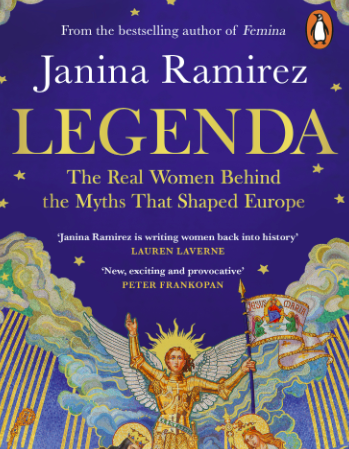
Historian and author Janina Ramirez has gained an excellent reputation for looking at history through the lens of women, who are often left out or have their contributions entirely forgotten. I very much enjoyed Femina, and the follow-up, Legenda, promised to look through the history of iconic women who had their names and reputations modified, manipulated, used, and abused down the centuries, often for political ends. So, how was it?
Well, Ramirez starts with an anecdote about far-right agitator Jean-Marie Le Pen and his bastardisation of the actions and sayings of Joan of Arc to build a case against Islamism. However, he misquotes the Maid of Orléans to suit his agenda, and he wouldn't be the first to do so.
Ramirez states that:
"Nationalism, by nature of setting one group of people against those outside that group, feeds on nostalgia and weaponises it, harnessing it to notions of separatism, racism, elitism and misogyny."
She is critical of the history curriculum taught and the complicity embedded within the reframing of national narratives. By looking at the stories and legends of these women, we can learn more of the truth, rather than the accretions and myth-making that have occurred centuries after their passing.
Ramirez looks at seven countries or regions—including France, the Iberian Peninsula, Greece, Germany, Italy, and Britain—to pair and contrast a modern figure with one from the eighteenth or nineteenth century. She states that she is compelled to do so because:
"As a historian I do not just deal with the past but also try to understand how humanity can come together peacefully to build inclusive societies that value equality, in hope of a better future."
She starts off with a great point: many countries have female personifications designed to represent a whole, unified people in one female form—think of the Statue of Liberty, Britannia with her lions and Union Flag shield, or Germania with her sword and armour. Yet real, flesh-and-blood women are often forgotten about, overlooked entirely, or have their biographies suitably altered to cater to the nationalistic and religious needs of certain parties. Take Elizabeth of Thuringia, who is venerated in Germany, Hungary, Czechia, Slovenia, Austria, Slovakia, and Croatia; many of these nations did not even exist when she was born, so she has been thoroughly co-opted.
Along the way, we meet the following women who helped shape history:
France: Revolution and Reinvention
Charlotte Corday: The murderess who killed Marat, a writer and government policymaker who sent many people to the guillotine and worsened life for the general populace during the Reign of Terror after the French Revolution. She is remembered for being upper-class, highly educated (especially in classical history), and deeply religious.
Joan of Arc: The young maid who led French forces, very successfully at first, against the English. There was a prophecy about a warrior woman from her home region and she leant into that, claiming that holy voices were guiding her. When captured, she was burnt and her ashes scattered in the Seine to prevent martyrdom. She lives on in sainthood and is represented across the country with many statues and monuments, far away from her home village of Domrémy.
Linked to her were other female mystics, including Hildegard of Bingen and Marie Robine, who predated Joan but had a similar modus operandi of mystical visions and voices. Julian of Norwich and Catherine of Siena also heard voices, but relayed them to religious authorities rather than keeping them secret for a period like Joan did; as a result, they received guidance and advice, whereas Joan (like Margaret of Antioch) was seen as a maverick and unpredictable in the eyes of church authorities.
Joan was also linked to Joanna of Flanders, another warrior woman who broke a siege and gained an unexpected victory. She was admired by Christine de Pizan, who wrote a poem about her, though this was largely ignored until the French Revolution brought a revival of Joan and the celebrated power of women.
Ramirez believes that "... the story of the poor, illiterate peasant girl who single-handedly saved a nation is a construct, not a reality."
Joan has gone through many mutations over the centuries—initially reviled, then revered—showing a chameleon-like ability to be all things to all people without truly belonging to either extreme (be it the alt-right asking for a "return to an authentic France" or the far left calling for an uprising against the bourgeoisie, technocrats, and autocrats).
The Iberian Peninsula: Dynasty and Discovery
Agustina: A soldier during the Spanish War of Independence who inspired many during frontline and guerrilla battles. She served her country well, but after the war found herself in the difficult position of having to return to civilian life and adopt the traditional role expected of women.
Isabella of Castile: Her reputation has grown through the centuries as Queen during the Spanish Golden Age and the Age of Discovery. However, her history is far murkier and warrants careful study, as she was a powerful woman from an era that demanded an acute awareness of court intrigue and shrewd politicking.
Her reign saw the completion of the Reconquista (the seven-century-long period of driving Muslims out of Spain), the persecution of Jews, and the rise of the Spanish Inquisition. An incredibly pious monarch, she ensured her Catholic faith came to the fore under her rule. Alongside this, she consolidated economic, legal, military, and political influence around herself and her husband—creating a new national identity that later rulers like Franco would exploit for their own gain.
Ramirez ends this chapter by noting that history often erases the multi-ethnic, culturally, and religiously diverse nature of the Iberian Peninsula, presenting Spain historically as a monocultural entity instead. Make no mistake, however: Isabella was an authoritarian who wielded incredible influence and power, leading to the enslavement and genocide of indigenous peoples across the Americas.
Greece: Autonomous and Atypical
Laskarina Bouboulina: Also known as the 'Greek Joan of Arc', Bouboulina was a fierce warrior widow who fought for Greek independence from Ottoman rule. Philhellenism (the love of ancient Greek culture) and the return of ‘Romaiko’—the rebirth of the imperial political glory of the Byzantine Empire—were alive and well in the 18th century, with many across Europe seeking to excise the Ottomans from the continent.
Anna Komnene: An 11th-century historian who wrote The Alexiad. Her monumental work documented the reign of her father, Byzantine Emperor Alexios I Komnenos, and the First Crusade. However, her contributions to the field were often credited to her husband, as it was believed a woman was incapable of authoring such a text. Coming from royal blood gave her the privilege and freedom to research and write. She was a Byzantine woman who followed in the footsteps of powerful empresses like Irene of Athens (co-regent, regent, and sole empress from 780 to 802), Euphrosyne (empress from 823 to 829), and Theodora (empress regent and monarch in her own right from 830 to 856), challenging rigid societal norms where the roles of men and women were strictly defined.
The Low Countries: Exceptional and Extreme
Julie Billiart, Françoise Blin de Bourdon, and Catherine Duchatel: The first three Sisters of Notre Dame de Namur, who maintained a secret Catholic school even under threat of death after the French Revolution in the early 19th century. This group also guarded centuries-old treasures and relics of their faith, which survive to this day.
Marie of Oignies: A 14th-century ascetic who gave up her middle-class family's wealth to serve lepers and the poor, striving to live as humbly as Christ. She experienced visions and engaged in self-harm to suffer as Christ suffered (imitatio Christi).
Hildegard of Bingen: An Abbess and legendary polymath who promoted a healthy body to foster a healthy soul—a century prior to the mortification and 'anorexia Christi' movement that swept across Europe and glorified suffering for Christ.
Christina the Astonishing: In the 12th century, Christina was declared dead, but during her funeral, she came back to life. She would throw herself onto fires and emerge apparently unscathed, hang herself from gallows and survive, and so forth. She was a true force of nature, but her extreme behaviour led to most religious organisations ignoring her.
Elizabeth of Spalbeek: She suffered stigmata on Fridays and performed exhausting, painful displays of Christ's suffering.
Lutgardis of Aywières: Another ascetic who went to extreme lengths to feel close to Christ.
These women inspired the Beguines movement, where communes of women joined together to help the poor and needy while imitating Christ's life. They also gained financial and social independence during a period (the 13th to 16th centuries) marked by a shortage of men and dowries due to constant Crusades and wars. The Beguines offered them a better life and a deeper spirituality. Key figures in this movement included Mechthild of Magdeburg and Marguerite Porete.
Germany: Bonds and Bloodlines
Lola Montez: A woman who became the courtesan of King Ludwig I of Bavaria and championed many liberal causes—including the plight of schoolteachers, wage increases, and investment in education—alongside a strong anti-Jesuit sentiment. She was an agent provocateur whom the Catholics and Jesuits deeply disliked.
Empress Adelaide: This 10th-century widow was promised the throne upon the death of her husband, the King of Italy. Imprisoned in a castle, she escaped and remarried, becoming the Holy Roman Empress and ruler of the Ottonian Empire in Germany. She ruled alongside King Otto and, through their children's alliances and marriages, became highly influential and respected. From Burgundian princess to Italian queen, German co-ruler to Holy Roman Empress and, finally, regent of an empire, Adelaide was extremely capable and powerful.
Italy: Piety and Papal Power
Anna ‘Nina’ Morisi: In the 19th century she worked as a maid, but when a Jewish child in her care became ill, she illicitly baptised him for fear of his soul entering limbo. The child recovered but was forcibly removed from his family, as Catholics could not live with non-Catholics at the time. This sparked international outrage over a child taken from his family through no fault of his own. The Pope was seen as the spiritual and secular ruler, but this overreach united disparate factions calling for a unified Italian state.
Catherine of Siena: The Patron Saint of Rome since the 19th century, Catherine was a great self-promoter in high demand from various church factions due to her numerous visions. She declared that she was married to Jesus and that he gave her a ring made of his foreskin (don't ask!). She also claimed to have the stigmata, though only she could see the marks.
I must say, out of all the women I've read about, Catherine of Siena seems to be the one who huffs her own guffs, and pretty hard at that. She was an avid self-promoter of the 'trust me bro' celebrity variety, and I find it rather vulgar. To each their own, but it leaves a bad taste in my mouth. True, she sought to weed out corruption and accretions that she felt had corrupted the true Catholic faith, but she placed herself firmly at the centre of it all.
Bridget of Sweden: Catherine of Siena's senior by 40 years, Bridget played a similar role and held significant influence over Pope Urban V, eventually being sainted by his successor, Pope Gregory.
Britain: Traditional and Transnational
Lady Godiva: The story of Godiva riding naked through Coventry on a dare to convince her husband to lower the tax burden is a hoary one. In truth, the eleventh-century Godiva was a formidable Anglo-Saxon ruler who held vast swathes of land before the Norman Conquest caused untold damage and altered England forever. Her historical reality was quickly erased to serve the myth of a passive, submissive noblewoman.
Rani of Jhansi: Like Godiva, the Rani saw her territory ruthlessly annexed by an external power—in her case, the British East India Company under the Doctrine of Lapse. Rather than submit, she led her troops from the front lines during the 1857 Indian Rebellion, becoming an enduring symbol of anti-colonial resistance even as British historians attempted to paint her as a bloodthirsty villain.
The Verdict
Ramirez leaves us with an urgent warning and a powerful call to action: legends are fluid, but the complex, real human beings beneath the myths are far more illuminating than any edited propaganda. In an era where history is routinely weaponised by politicians and extremists—and truth itself is threatened by digital manipulation—reclaiming these forgotten stories is essential.
Nation-building does not belong to the powerful few; it belongs to all of us. By seeking out cross-cultural truths and uncovering women’s hidden pasts, we protect historical reality from manipulation and reclaim a far more inclusive future.
LINK- Toxic: Women, Fame and the Noughties- Book Review (and Some Thoughts)
LINK- The Rise of Retro Gaming During Covid
LINK- Japan: My Journey to the East
LINK- Blood, Sweat and Pixels- Book Review
LINK- Utopia for Realists- Book Review
LINK- ‘Natives: Race and Class in the Ruins of Empire’ LINK: Elden Ring- Videogames As Art