
Battle Royale High School - Cult Manga Review

If you're a fan of classic '80s OVAs that throw caution (and coherent plotting) to the wind in favor of non-stop action, gore, and sheer absurdity, then Battle Royale High School is a must-see. This 1987 one-shot anime, not connected to the popular film duology (starring Beat Takeshi) or manga, is an hour-long, unhinged journey that somehow manages to cram just about every genre imaginable into its runtime.
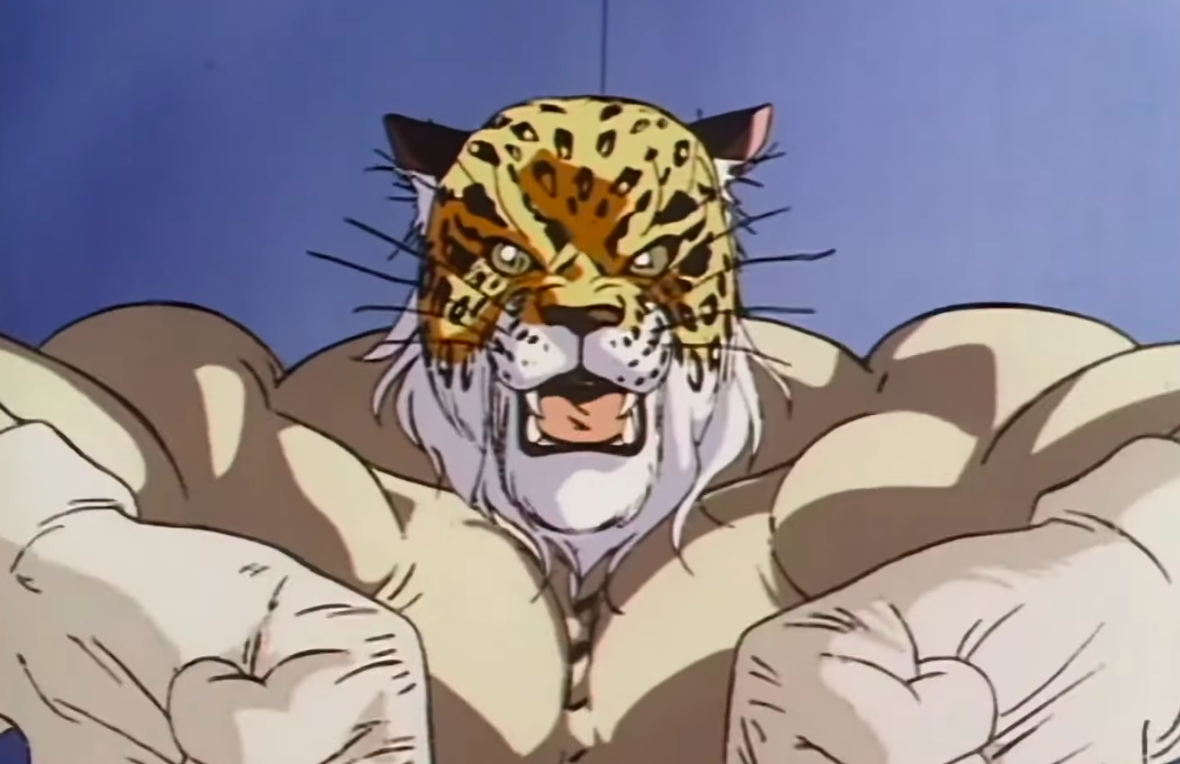
The story, such as it is, centers on Riki Hyoudo, a high school karate champion with a penchant for wearing a leopard mask. Riki's martial arts prowess, it turns out, is tied to an ancient interdimensional prophecy. He's psychically linked to Byoudo, the demon king of the Dark Realm, who, thanks to some fairy mischief and a lightning ball reminiscent of Arnold's first appearance as the Terminator, finds himself on Earth and eventually possesses Riki. From there, things spiral gloriously out of control. We're introduced to a stern demon slayer, a space/time continuum inspector in power armor, a love triangle, grotesque monsters, and enough exploding bodies to make your head spin. The plot is less a cohesive narrative and more a series of escalating, wildly entertaining events designed to facilitate as much over-the-top violence as possible.

This OVA delivers on its promise of ultra-violence as the fight scenes are frequent, well-choreographed, and genuinely brutal. There's plenty of blood, dismemberment and exploding demons. The pacing is a non-stop assault of events and there's rarely a dull moment as the story rushes from one ridiculous scenario to the next.

The animation and character designs are a fantastic blend of '80s and early '90s aesthetics, with Nobuteru Yuki who would later work on the stunning The Vision of Escaflowne, handling character design. Hideaki Anno and Shirō Sagisu, who worked on Evangelion several years later, both worked on this too so there is some pedigree. However, don't go in expecting a deep or logical story as characters appear and disappear, motivations are thin, and the plot often feels like an afterthought to the action. It's less a narrative and more a series of connected set pieces. There's virtually no time for character development; everyone is an archetype, serving simply to move the carnage along. The sheer absurdity of it all, especially in the English dub, can lead to some genuinely laugh-out-loud moments, though not always intentionally.

So, if you can turn off your brain and just enjoy the ride, Battle Royale High School is incredibly fun. It's the kind of "so bad it's good" experience that cult classics are made of.

Battle Royale High School is absolutely worth watching if you appreciate the wild, untamed spirit of '80s anime OVAs. It's not a masterpiece by any means but it's a fantastic example of spectacle and immediate gratification in lieu of any real meaning. It's a loud, bloody, and thoroughly enjoyable hour of anime that embraces its own ridiculousness. It's well worth an hour of your time.

Gunbuster - Cult Manga Review

Animation studio Gainax closed a couple of years and it sent shockwaves through the animation world. The studio was renown for Evangelion and Nadia: The Secret of Blue Water but it initially reached fame in 1988 with Gunbuster. I had seen most of the series but had never got to Gunbuster so thought I'd better give it a looksie.

I can say that Gunbuster, directed by Hideaki Anno, is a masterclass in how to blend high-concept science fiction with deep emotional stakes. It occupies a unique space in anime history, functioning as a bridge between the traditional Super Robot shows of the 1970s and the psychological deconstructions seen in the 1990s.

The story follows Noriko Takaya, a young girl living in the shadow of her father, a decorated Admiral who vanished during an alien ambush. When she is recruited into an elite space force to protect Earth, she must grapple with her own insecurities and the weight of human survival, a premise that feels remarkably similar to Orson Scott Card's Ender’s Game.

For modern viewers, Gunbuster could be seen as a fascinating prototype for Neon Genesis Evangelion. Many of Anno’s signature tropes are already present here, including the reluctant teenage pilot, the demanding commander, and sharp internal team rivalries. The character Jung Freud, a formidable redhead, clearly paves the way for future archetypes like Asuka. While the series starts with familiar genre beats, it quickly evolves into something much more profound by centering the narrative on the terrifying realities of interstellar combat.

One of the most impressive elements of the series is its commitment to the physics of special relativity. Unlike many sci-fi series that ignore the vast distances of the cosmos, Gunbuster uses time dilation as its primary emotional engine. As Noriko and her companions travel at near-light speeds, months in space result in years passing on Earth. This creates a tragic disconnect between the heroes and the people they are trying to save, as friends and family age and move on while the pilots remain physically unchanged. This hard-science approach elevates the series from a simple action show to a sophisticated meditation on sacrifice and isolation.

© BANDAI VISUAL © GAINAX

Technically, the animation has stood the test of time exceptionally well, showcasing the meticulous mechanical detail for which early Gainax became famous.

The finale of Gunbuster is a masterstroke of avant-garde direction. In a bold departure from the vibrant aesthetic of the earlier episodes, Hideaki Anno shifts the series into a high-contrast, black-and-white widescreen format. This stark change strips away distractions, emphasizing the monumental scale of the conflict and the profound isolation of its characters.

By utilizing detailed line art and cinematic composition, the show transforms from a standard mecha action story into an evocative, historical epic. It is a brilliant artistic choice that turns production limitations into a hauntingly beautiful meditation on sacrifice, leading to a conclusion that still feels powerful after nearly 40 years. Even without the typical flourishes of late-80s animation, the sheer weight of the narrative is felt in every frame.

Overall, Gunbuster is an essential watch for anyone interested in the evolution of mecha or the early works of Hideaki Anno, proving that even after decades, its message about human perseverance still rings true. Sure, some episodes contains some dated fan service elements but this was a common staple of late-80s OVA culture and these are relatively brief, but this is a minor content warning for contemporary audiences. Miss this to your detriment.

LINK- Pure Invention: How Japan's Pop Culture Conquered the World- Book Review (and Personal Reflections)

LINK- Japan: My Journey to the East

LINK- Akira Soundtrack Vinyl Review

LINK- Battle Angel Alita: And So It Ends

LINK- Fire Tripper: Cult Manga Review

LINK- The Future Starts Here: An Optimistic Guide to What Comes Next- Book Review

LINK- On Mysticism by Simon Critchley- Book Review

LINK- The Power of Stories and How They Are Manipulated

LINK- The Message by Ta-Nahisi Coates - Book Review (and Some Thoughts)