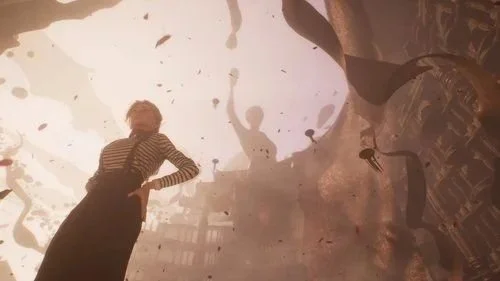
Comic books are often dismissed as simple power fantasies, but the medium has a long, potent history of holding a mirror up to the darker corners of human nature. I've written a few articles over the years on this topic, but I recently got around to reading the DC Compact edition of Supergirl: Woman of Tomorrow. In issue #3 (by writer Tom King and artist Bilquis Evely), a brightly coloured sci-fi adventure pivots into a devastating exploration of Hannah Arendt's concept of the "banality of evil". The issue demonstrates just how effectively comics can tackle horrific real-world subject matter in a sensitive and thought-provoking way.
The Atrocity at Maypole
When Kara Zor-El (Supergirl) and her companion Ruthye track the fugitive killer Krem to the planet Corunn, they arrive in Maypole—an idyllic, polite town that looks like a calm, 1950s-style American suburb populated by blue-skinned aliens ("the Blues"). However, beneath the manicured lawns lies a grotesque secret: when space-faring mercenaries known as the Brigands threatened their world, the Blues made a chilling bargain. Rather than fighting or risking their own lives, they paid the Brigands specifically to murder and wipe out the planet's purple-skinned minority ("the Purples") in a segregated enclave known as "Purple Town". Krem, an imprisoned outsider at the time, actively assisted in the slaughter before being released and sheltered by the townspeople.
Standing before the mass graves outside Purple Town, Supergirl is forced to confront a soul-crushing truth: even with god-like power, she cannot simply punch her way out of systemic cosmic evil, nor can she cure the quiet complicity of an entire society that chose genocide for their own comfort.
Allegory, History, and Geopolitics
Because of the issue's heavy themes, I did some research online to see if King was drawing direct parallels to modern geopolitics, specifically comparing the plight of Purple Town to the Israeli-Palestinian conflict in Gaza. As it turns out, Supergirl: Woman of Tomorrow #3 was published in August 2021—well before the escalations in Gaza that began in October 2023—and King has never stated that the story was intended as a direct allegory for that specific conflict. While conflict in the region has been ongoing since the 1948 Nakba, the issue draws just as heavily on much older, universal history—from European colonialism to global instances of state-sanctioned ethnic cleansing.
I think this tendency for audiences to apply this modern geopolitical lens has been further fuelled by James Gunn’s 2025 Superman film. Although I still haven't actually seen the film myself yet, it was practically impossible to miss the endless chatter and debate across social media regarding its fictional conflict between Boravia and Jarhanpur, which many viewers interpreted as an explicit real-world proxy.
The Universal Canvas
Instead, King channels universal historical patterns—drawing on his own past real-world experiences to explore displacement, segregation, and ethnic cleansing. The chapter resonates precisely because it avoids being a one-to-one cipher for any single event.
By cleverly abstracting human cruelty onto an alien canvas, the comic strips away our political tribalism and forces us to confront a terrifying reality: evil rarely arrives looking like a cackling monster. Far more often, it presents itself as a polite neighbour, a tidy street, and an entire community looking the other way while their comfort is bought with blood.
It's something I mentioned in my review of Patlabor 2: The Movie, as a protagonist in that anime masterpiece opines:
"We export the realities of war and import the fruits of its labour. We call it a peace, but it's a fraudulent peace—until the front lines come home eventually."
In Supergirl: Woman of Tomorrow, those front lines are buried right under the manicured lawns. I haven't seen the 2026 Supergirl film yet, but I hope it does the source material justice, as the message contained is universal: be a good neighbour, and don't be a dick.
LINK: The Evolving Fears of a Horror Gamer
LINK: The Power of Stories and How They Are Manipulated
LINK: The Message by Ta-Nahisi Coates - Book Review (and Some Thoughts)
LINK: Utopia for Realists- Book Review
LINK: Toxic: Women, Fame and the Noughties- Book Review (and Some Thoughts)