As Above, So Below - Cult Film Review

As Above, So Below is one of those rare found-footage films that actually uses its ‘shaky-cam’ style to tell a smart, high-concept puzzle house-type story. It feels like a cross between The Blair Witch Project and Indiana Jones, seasoned with the claustrophobic dread of The Descent. While that sounds like a lot to juggle, the film blends these influences into a surprisingly effective, low-budget gem.

The story centers on Scarlett Marlowe, a character who plays like a modern, more obsessed version of Lara Croft. She is highly educated, dangerously driven, and entirely unafraid to drag her reluctant "frenemy" and a small film crew into the mouth of madness in her search for the legendary Philosopher’s Stone. The relic was said to turn base metals into gold but to attain it their search leads them from ruins in Iraq to the dark catacombs of Paris.

What sets this film apart is its commitment to historical detail. It doesn't just use the Paris Catacombs as a spooky backdrop; it weaves in actual alchemical lore and history to ground the supernatural chaos. By the time the crew is navigating the literal and metaphorical circles of hell, the film has successfully blurred the lines between archaeology and the occult. The shift from intellectual puzzle-solving to a fight for survival is jarring in the best way possible.

The film’s greatest strength lies in its namesake. I did some research after the film and found that the ancient axiom "As above, so below" suggests that the universe mirrors the individual. In Scarlett’s world, this translates to a terrifying reality where the physical traps of the catacombs reflect the internal demons and guilt of the explorers. The deeper they go into the earth, the deeper they are forced to go into their own fractured psyches. The tunnels aren't just haunted; they are responding to the characters' past mistakes.

Sure, the film isn't without its flaws like some of the acting is a bit over-the-top and iverly-dramatic, and it leans heavily on typical found-footage tropes, but for a film of its scale, it punches well above its weight class.

Overall, As Above, So Below is an ambitious, though-provoking horror movie that proves you don't need a massive budget to be both intellectually stimulating and genuinely terrifying. It’s a descent well worth taking, even if it doesn't totally pull it off.

LINK: Japan: My Journey to the East

LINK: Please Save My Earth - Cult Manga Review

LINK: Thomas Was Alone Video Game Vinyl Soundtrack Review

LINK: Akira Soundtrack Vinyl Review

LINK: The Power of Stories and How They Are Manipulated

LINK: The Message by Ta-Nahisi Coates - Book Review (and Some Thoughts)

LINK: The Anxious Generation: Book Review (and Some Thoughts)

LINK: Utopia for Realists- Book Review

LINK: Toxic: Women, Fame and the Noughties- Book Review (and Some Thoughts)

Twins of Evil- Cult Film Review

My love for old horror films started in my formative teen years. The BBC would show cult horror films late on Friday and Saturday nights in the early to mid-90s and, when we got Sky, late 90s/ early 2000s Bravo Channel. Some were the more salacious films of 60s and 70s European cinema, often in the horror genre but not always-  some were experimental pieces which had a deeply ethereal feel and long moments of quiet where the gorgeous scenery and silence would wash over you. It was here I first saw Circus of Horrors, Vampiros Lesbos, The Witchfinder General and many, many more.

It was during this time that I first watched Twins of Evil. I decided to revisit the film for the first time in over 25 or so years to see if it was worth the cult classic status it has acquired over time.

The story is quite simple: At a village where superstition reigns supreme, a young woman is burned at the stake for being a witch by a band of puritans. Maria and Freida, played by the identical Collinson twins, are placed under the care of their puritanical uncle, played by an ever reliable Peter Cushing. The twins are identical in looks but very different in nature with Maria being kindhearted but Frieda being selfish and hedonistic. When Frieda secretly allies with the pleasure seeking Count Karnstein (played with suitable arrogance and charm by Damien Thomas) and is turned into a vampire, her sister seeks to get her back but is it too late?

The film is based on Sheridan Le Fanu's Carmilla but apparently this film changes quite a lot from the source material. As it is, the film is a very simple story of good and evil and the nature of humans. It's not a deep character study like The Blood on Satan's Claw or The Wicker Man but it is quick disposable fun that shows Hammer at its cheesy average.

The cinematography by the awesomely named Dick Bush is solid and the Harry Robinson composed music surprisingly jaunty, especially over the opening credits as a poor woman is writhing in agony as the flames overtake her body. Director, John Hough, knows his remit and that is to let his star actresses take the spotlight and shine in their title roles.

The film is fine but that's it. The twins are solid in their roles whilst Cushing and Thomas play their roles with suitable gravitas but the story is slight and there are few surprises. It's a recommend from me for nostalgia's sake but there are definitely better horror films from the period out there.

LINK: Kolchak: The Night Stalker- Cult TV Series Review

LINK- Twin Peaks Retrospective

LINK- The Transportive Nature of Objects (And the Power of Mini Consoles)

LINK- My One True Gaming Constant in Life- Nintendo

LINK- On, and On and Colston (Or, ‘How We Learned to Talk About the Legacy of Colonialism in GB’)

LINK- ‘Natives: Race and Class in the Ruins of Empire’

LINK: Let’s All Create a ‘New Normal’.

The Witchfinder General- Cult Film Review

My love for old horror films started in my formative teen years. The BBC would show cult horror films late on Friday and Saturday nights in the early to mid-90s and, when we got Sky, late 90s/ early 2000s Bravo Channel was a real boon. Some were the more salacious films of 60s and 70s European cinema, often in the horror genre but not always-  some were experimental pieces which had a deeply ethereal feel and long moments of quiet where the gorgeous scenery and silence would wash over you. It was here I first saw Circus of Horrors, Vampiros Lesbos, Twins of Evil and many, many more.

For this dark season, I thought I'd watch the unholy trinity of British folk horror; The Witchfinder General, Blood on Satan's Claw and The Wicker Man. No, not the Nic Cage remake. Now, say it after me…

A true crime against nature.

I saw Witchfinder General on Bravo back in the late 90s/ early 00s I believe. I hadn't seen it since then but remember the violence being quite disturbing at the time.

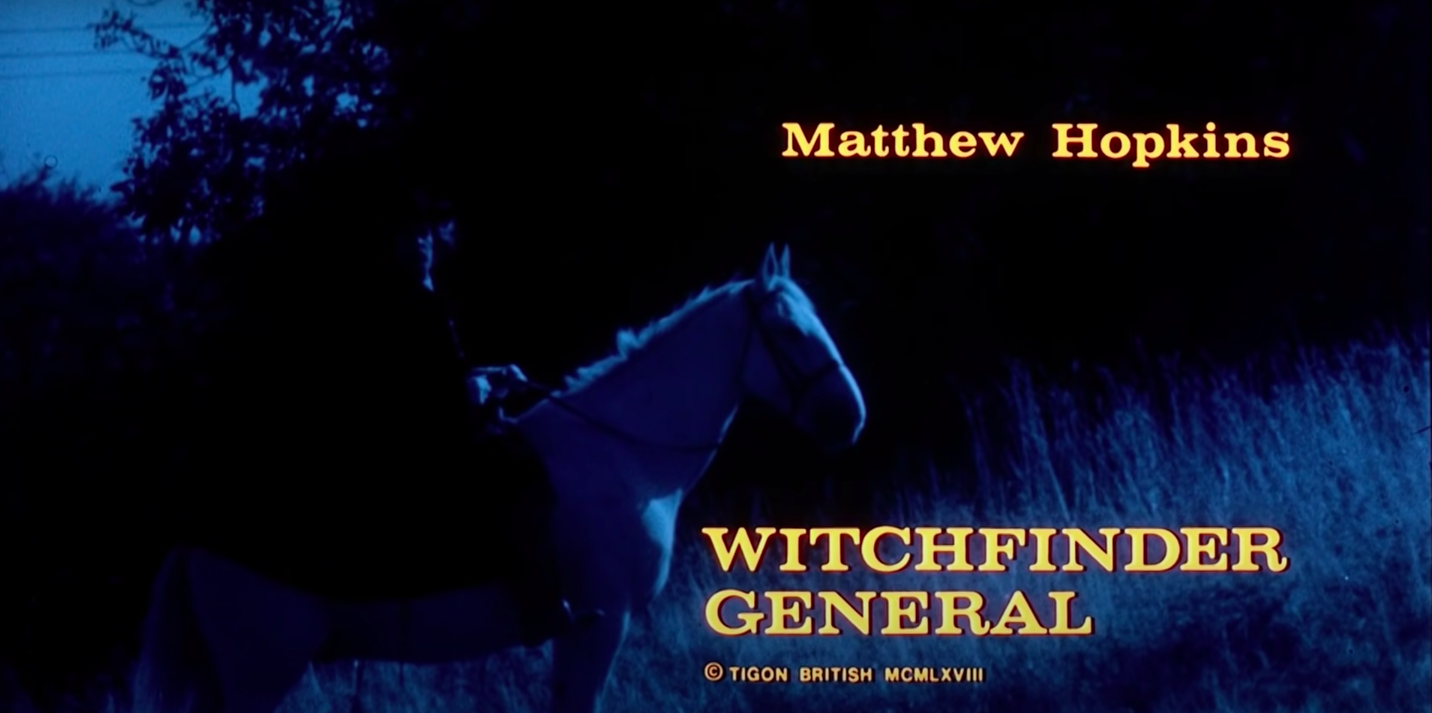
It starts off with a quiet countryside scene with lush green grass and lolling sheep. It quickly cuts to a hangman setting up a gallows on a hill whilst  a mob drags an old lady up to it. Whilst the priest recites the last rites the noose is put around the old lady and the stool is kicked away from underfoot, she swings and it smash cuts to Vincent Price as Matthew Hopkins, the Witchfinder General, watching from astride his white horse. For a cold open, this scene is brutal and it doesn't stop there. The statement of intent has been set and it's not backing down.

The smashcut of Vincent Price is brilliant and the beginning is brutal.

The music by Paul Ferris kicks in to offer a brief moment to catch your breath as the credits roll. When the narrator sets the scene about 1665 and the English Civil War, we see that the rule of law is broken and cruelly inequal- dispensed without due process.

When a Roundhead soldier, Richard, is given leave after saving the life of his captain, he goes to see his lady love, Sarah. Her uncle gives him permission to marry his niece but wants him to take her away as the threat of being accused of witchcraft hangs over the area. The soldier returns to his regiment but, unfortunately, the following day the Witchfinder General comes to town and falsely accused the priest. He makes advances against the niece and, in exchange for a night with her, promises to free the priest. When Hopkins goes to a nearby town, his second in charge, John Stern, assaults the niece too. The priest is then dunked in the water and hanged for witchcraft as the niece's sway is lost.

The soldier returns to his love and promises to avenge the priest's death and the loss of her innocence by killing the witchfinders. What follows is a cat and mouse chase as the soldier looks to catch up to the witchfinders whilst they continue to carry out their dreaded executions.

The film is brutal in it's portrayal of violence done against the innocent and voiceless but the threat of cynical Puritanism and greed that underline this dark tale, still persist in today's world. The cinematography by John Coquillon is stunning shot as the beautiful greens of the beginning  contrast against the autumnal colours when Hopkins comes to town and brings his brand of justice. The costumes are on point and whilst you can tell that this isn't an expensive production, the economy of design lends it a charming period look.

Even after nearly 50 years, the depravity shown is still shocking but the tale of systemic violence done against women whilst the community watches is still relevant and prescient even of the rise of the far right and populism where hardwon womens' rights and liberties are being rolled back for a similar puritanical zealousness, underpinned by greed and power. Director Michael Reeves, who died tragically young, has created a film that has stood the test of time and is prescient.

LINK- Children of the Stones: Cult TV Series Review

LINK- Dead of Night: Cult TV Review

LINK- The Stone Tapes: Cult TV Review

LINK- Tom’s Midnight Garden: Cult TV Review

LINK- Children of the Dogstar: Cult TV Series Review

Kolchak: The Night Stangler- Cult Movie Review

A while back, I watched the 20 episode television series of Kolchak, after having had the DVD collection for years. I had heard it mentioned often when The X Files was at its peak. I thought the series was excellent and could understand why it had achieved cult status over the past 50 or so years; it had a late night pulpy horror charm. I’d also watched the first movie and found that the production values were high in this slower paced affair. The tightness of the film made it watchable and exciting, even with the dated makeup effects.

It was with some excitement that I watched the follow up movie, Kolchak: The Night Strangler. It follows our intrepid investigator as he is down in his luck in Seattle a year after the incidence in Las Vegas. A chance meeting with his old editor Tony Vincenzo places him on a path to track down a serial strangler in Seattle. Every 21 years, a sequence of murders occurs within the same few blocks and so Kolchak seeks the killer who has possibly discovered the elixir of life.

Like its predecessor, the show is well produced with great cinematography highlighting the cityscape of Seattle. The story is intriguing and Kolchak (Darren McGavin) has lots of fun interactions with the office staff as he is trying to save the case. The old Seattle catacombs are an excellent location for this mystery and lends the whole film that 70s griminess.

The Golden Voyage of Sinbad- Cult Movie Review

The Golden Voyage of Sinbad is the second of the trilogy of Sinbad films that Dynamation stop-motion monster movie creator Ray Harryhausen made for Columbia, the others being The 7th Voyage of Sinbad (1958) and Sinbad and the Eye of the Tiger (1977). In the three movies created by Harryhausen and director Charles H. Schneer, it often sits comfortably in the middle or at the top but it's all relative and heavily based on nostalgia. Nonetheless, what it does have is a popular b-list cast of actors, amazing mythical monsters and a simple but engaging enough story.

The plot follows Sinbad as he comes into possession of part of a tablet which is dropped by a mysterious homunculus. He finds out that the tablet is a single part of three which shows a nautical chart to the mysterious land of Lemuria and a special treasure. Ably supported by the Grand Vizier Of Marabia, a slave girl (played by genre favourite Caroline Munro) and his loyal crew, Sinbad attempts to get to the Fountain of Destiny before the evil magician Koura (an effectively villainous pre-Dr Who Tom Baker) who wishes to extend his life and use the power for his own nefarious means.

I remember watching the film in my youth and falling in love with the Harryhausen monsters (as well as stunning Munro). The sweeping cinematography and Arabesque music lent it all a sense of the exotic and, I can say even after all this time, it is still thoroughly watchable.

Even though the production was made on a shoestring budget you wouldn't know it as the film has some stunning matte art for the backgrounds, seemingly inspired by the Angkor complex in Cambodia, giving it a sense of grandeur and space. The costumes are sumptuous and present the atmosphere of Arabian Nights. The dialogue is basic but does feature some great one-liners like, 'My heart is full of bravery but I have very cowardly legs.'

However, once again, it is the Harryhausen Dynamation process that raises the whole production as we see a possessed ship's figurehead come to life as well as mythical beasts like a centaur and griffin and the goddess Kali.

If you're looking for a quick matinee fix for a rainy afternoon over Easter, this is the movie for you.

LINK- The 7th Voyage of Sinbad- Cult Movie Review

LINK- Into the Unknown Exhibition Shines Bright at the Barbican

LINK- Ray Harryhausen: Titan of Cinema Virtual Exhibition Experience- Review

LINK- Children of the Stones: Cult TV Series Review

LINK- Tom’s Midnight Garden: Cult TV Review

LINK- On And On And Colston ( Or, How We Kinda Sort of Learned to Talk About the Legacy of Colonialism and the British Empire)

LINK: Japan: My Journey to the East

LINK- Pure Invention- Book Review